
A Preliminary Study on the Effectiveness of Pharmacists' Counselling on Inhaler Technique in Patients with Chronic Lung Disease
Keywords:
counselling, dry powder inhalers, Malaysia, metered-dose inhalers, pharmacistsAbstract
Introduction:
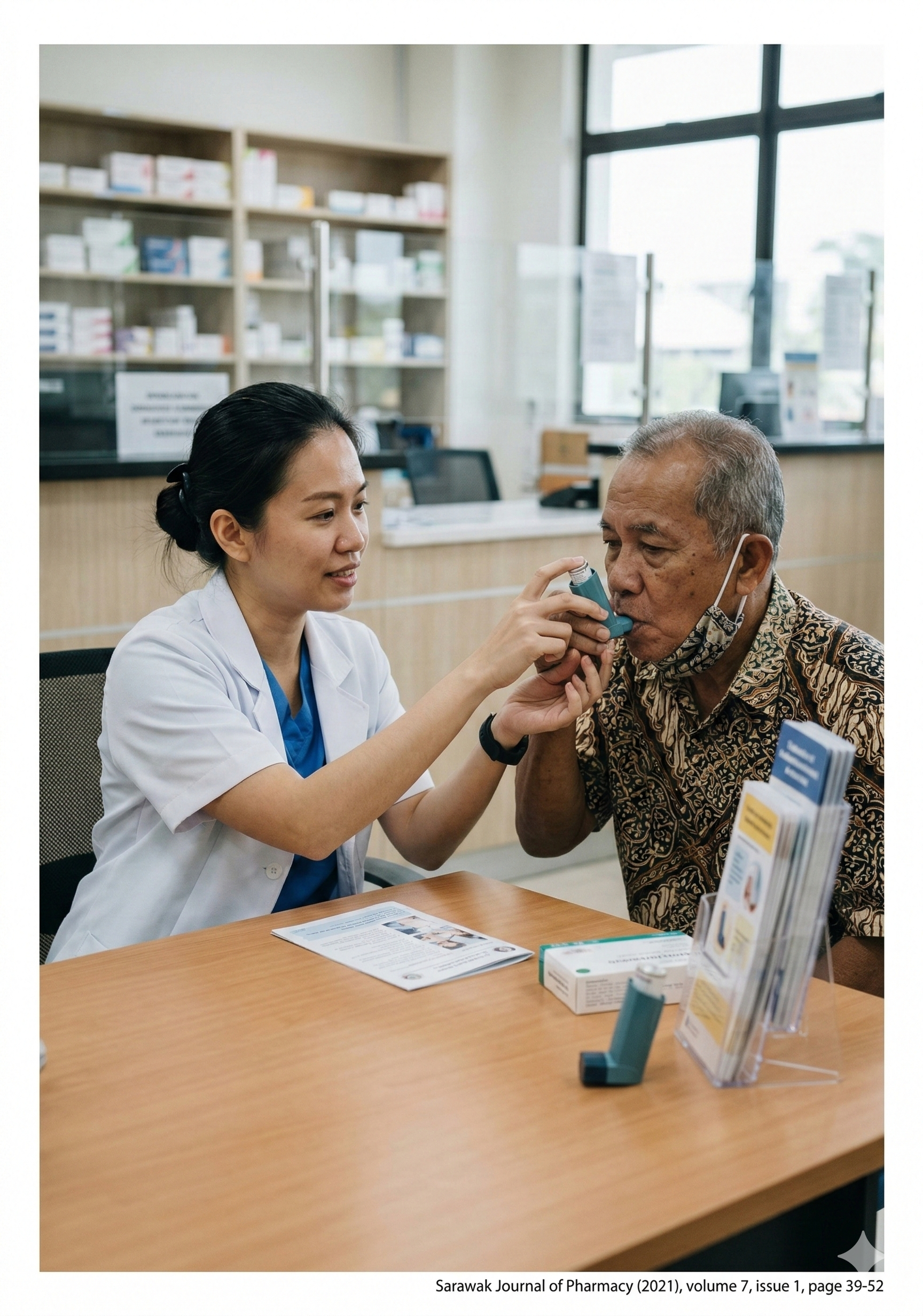
In managing patients with chronic lung diseases, the correct use of inhaler devices is crucial to ensure adequate drug delivery. This study aimed to examine the effectiveness of pharmacists' counselling on inhaler techniques among patients with chronic lung diseases in Sarawak, Malaysia.
Methods:
This study involved patients with chronic lung diseases admitted into the general medical wards in Sarawak General Hospital. Those prescribed with any of the five types of inhaler devices, including metered-dose inhalers (MDI), MDI + spacer, Turbuhaler®, Accuhaler® and Handihaler®, were recruited. The inhaler technique for each inhaler device was assessed using a 6-step device-specific checklist adapted from a local protocol. Each step of the inhaler technique contributes one mark, with a total score ranging from zero to six. A total score less than four indicates the "Poor" technique; four to five indicates "Satisfactory"; and six indicates "Good". Assessments were performed on admission (t1), upon discharge (t2) and four to six weeks post-discharge (t3). Counselling by ward pharmacists was performed right after t1. The change in percentage of participants measured effectiveness rated "Satisfactory/Good" from t1 to t2 and from t2 to t3, respectively, following per-protocol analysis.
Results:
Two hundred participants were recruited, four of whom passed away before discharge, and a further 83 patients were lost to follow-up at t3. Hence, 196 and 113 responses were included in the outcome analyses upon t2 and t3, respectively. Most participants (88%) were pre-existing inhaler devices users. Pharmacists’ counselling resulted in statistically significant (P < 0.05) improvements in the percentage of participants with “Satisfactory/Good” inhaler technique for the MDI (from 63.6% to 100%), MDI + spacer (from 64.3% to 96.4%), and Turbuhaler® (from 50.0% to 100%) at t2, but not Accuhaler® (from 87.5% to 96.9%) and Handihaler® (from 80.0% to 100%). The improvements were sustained until t3. Notably, more of Accuhaler® and Handihaler® users had "Satisfactory/Good" inhaler technique upon admission than other inhaler devices.
Conclusion:
This study provided preliminary evidence on the impact of pharmacists' counselling on the inhaler technique of inhaler devices.
 Sarawak Journal of Pharmacy